
We are honoured to be featured by Grape Magazine as one of the first Greek publications to introduce the Women in Wine Expo Aegean Edition, coming to Thessaloniki in May 2027. The article is in Greek, with an English translation available below.
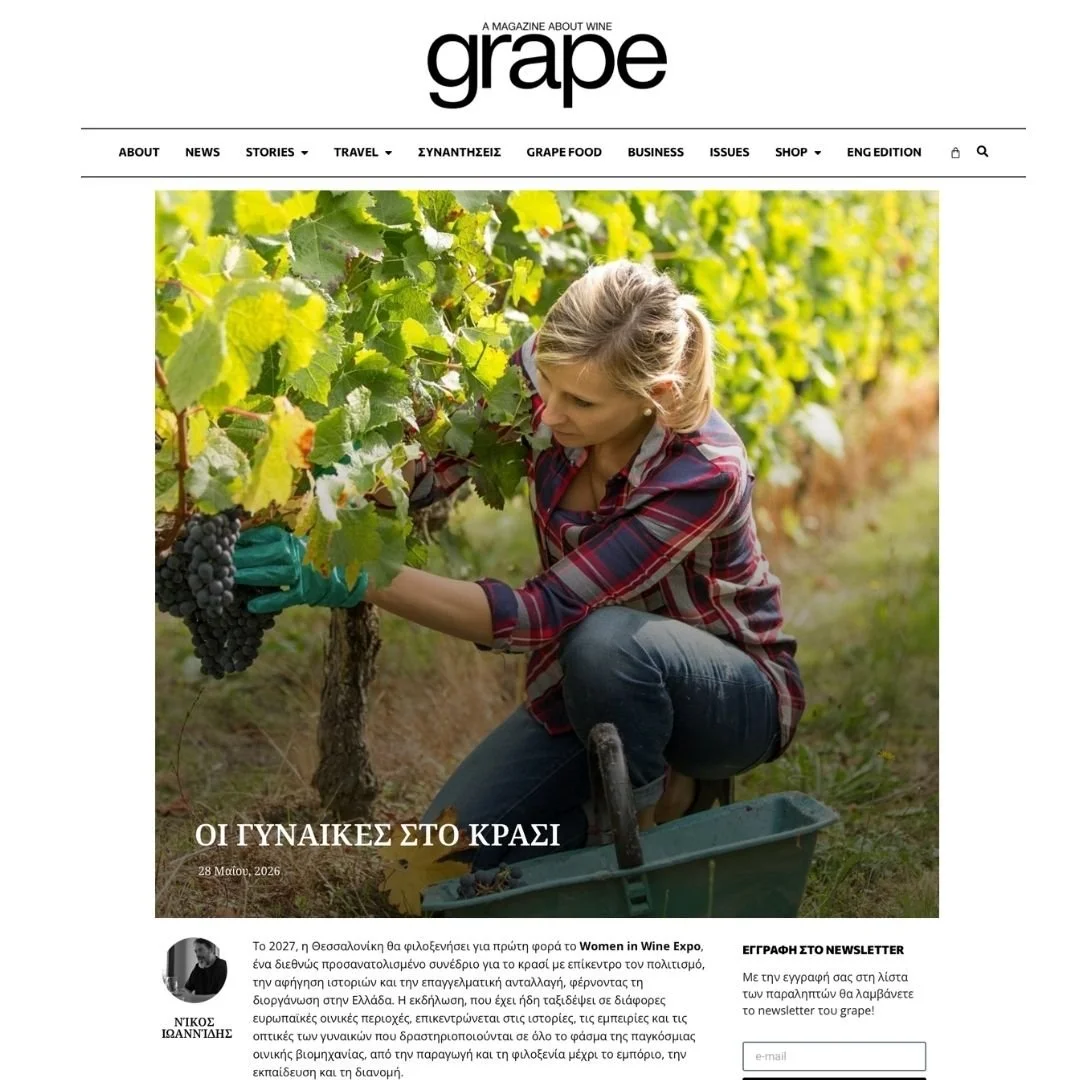
In 2027, Thessaloniki will host the Women in Wine Expo for the first time, bringing an internationally minded wine conference focused on culture, storytelling and professional exchange to Greece. The event, which has already traveled through several European wine regions, focuses on the stories, experiences and perspectives of women working across the global wine industry — from production and hospitality to trade, education and distribution.
For the Thessaloniki edition, the focus will shift strongly toward the Eastern Mediterranean and the Aegean region. Beyond networking and business, the organizers want to create space for the voices of Greek women in wine, alongside perspectives from across the Aegean and Balkan wine worlds — regions where wine culture is closely tied to family life, hospitality, migration, identity and local tradition.
The Women in Wine Expo was founded in 2019 by Senay Özdemir, a journalist and former television presenter who in recent years has been professionally active in the wine industry through the import company House of Red & White in the Netherlands. The idea emerged through her continuous interaction with women producers, sommeliers, buyers and wine professionals from different countries who were active in the sector but had significantly less visibility than their male colleagues, particularly in international networks, trade access and public presence.
What began as a small professional networking initiative quickly evolved into an international event that moves to a different country each year. After editions in the Netherlands and Belgium, Georgia, London, Porto and Tokaj, WIWE collaborated this year with ProWein in Düsseldorf following an invitation from the exhibition organizers.
As part of this collaboration, a masterclass was organized featuring four women producers from different countries, who presented their wines and work to professionals from the international wine trade. The wines were made by women winemakers from cool-climate regions Canada, Poland, England and Sweden — examples of emerging or evolving wine regions increasingly shaped by climate change and new viticultural possibilities.
“The market needs stories,” says Senay Özdemir. “Importers and distributors are now looking for different narratives around wine, and women have very powerful stories to tell.”
That philosophy is expected to shape the Thessaloniki edition as well. Rather than functioning purely as a traditional trade conference, WIWE aims to create a more intimate international gathering where wine becomes a starting point for broader conversations about culture, heritage, hospitality and regional identity.
The program is expected to combine conversations, tastings, winery visits and cultural gatherings focused on the wine traditions of the Eastern Mediterranean and the Aegean region. Alongside professional networking and exchanges, the organizers aim to create space for more personal encounters around identity, local food culture and the role of women in shaping contemporary wine narratives.
Part of the program will likely include visits to wineries in Northern Greece, discussions around indigenous grape varieties and Mediterranean gastronomy, as well as conversations bringing together voices from Greece, the Balkans and neighboring Aegean wine regions.
Although the presence of women in the wine industry is far more visible today than in the past, inequalities within the sector remain significant, especially at higher managerial and commercial levels. In many major wine markets, women are increasingly present in roles such as oenologists, educators and hospitality professionals, yet senior leadership and ownership positions remain disproportionately male.
In Australia, one of the few countries with detailed industry data, studies show that women continue to be underrepresented in senior management roles and winery ownership, while more often concentrated in operational or support roles — a pattern that also affects wage structures within the industry. At the same time, female leadership appears to have a broader impact, with a higher presence of women in winemaking and viticulture roles in companies already led by women.
Senay Özdemir places particular emphasis on the career gap created when many women are forced to temporarily interrupt their professional path after starting a family. In production, harvesting and hospitality, demanding schedules and the need for continuous presence often make it difficult to maintain an uninterrupted career.
“We see many women stepping away for a period when they start a family and then trying to return by starting over again,” she notes.
Similar discussions have emerged in recent years around pay inequality in the wine and hospitality industries. In the United Kingdom, where women are strongly represented in the wine trade, industry organizations continue to push for greater salary transparency and equal pay for equivalent positions, as gaps remain visible even in mature markets.
She avoids presenting WIWE as an organization positioned against men or as an initiative focused solely on representation. Instead, she describes it as an international professional network designed to give women in wine greater access to markets, contacts and opportunities that have traditionally developed within more closed and often male-dominated environments.
“Women have always worked in wine,” she says. “They worked alongside their husbands, fathers or brothers, but usually their names never made it onto the label.”
She is also aware of the social prejudices that still accompany women working professionally with alcohol, particularly in more conservative societies. Coming from Turkey, she notes that wine is still sometimes viewed with suspicion when associated with women.
“Many people do not understand that working in wine does not simply mean drinking wine. It is knowledge, education and professionalism,” she says.
With its dynamic gastronomy scene and its position at the center of Northern Greece’s wine-producing regions, Thessaloniki offers a natural setting for an international gathering focused on wine, culture and regional identity. From Santorini to Naoussa and the vineyards of Northern Greece, women are also playing an increasingly visible role in shaping the contemporary image of Greek wine.
As the international wine industry searches for new voices and more authentic perspectives, the arrival of the Women in Wine Expo in Greece may also reflect a renewed appreciation for the wine cultures of the Eastern Mediterranean — where wine remains closely connected to hospitality, memory, landscape and everyday life.